Conditional verdict: Buy this package conditionally if you need a compact, metric-only instrument for documented spot readings on prepared, accessible vibration points and you value a magnetic pickup plus a standard 10 mm probe in one kit. Skip it if you need stored histories, exports, FFT spectra, automated alarms, a compliance certificate, or a diagnostic verdict.
As an Amazon Associate I earn from qualifying purchases.
Check the PCE-VT 1100M offer on Amazon
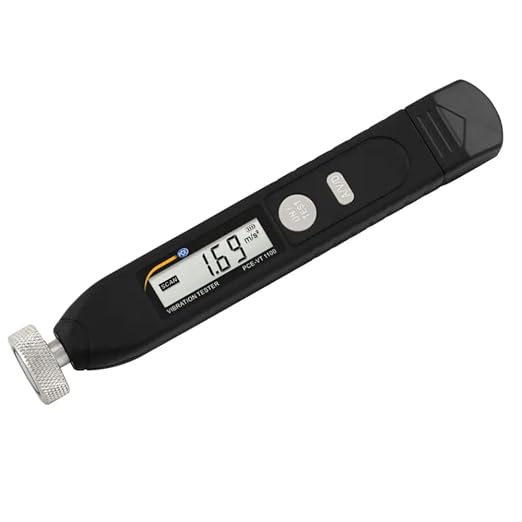
A small meter for a specific measurement job
The PCE-VT 1100M is best understood as a handheld comparison instrument, not a complete condition-monitoring program. It is intended to let a user take an on-site reading, compare that reading with another machine or a later reading, and write down the result. The manufacturer describes metric measurement of acceleration, vibration velocity, and displacement, with an LCD response time of about one second. That makes the package practical when the question is narrow: what vibration value is present at this accessible point right now? [1]
Its compact body is about 155 x 24 x 18.7 mm and weighs approximately 40 g including batteries. That form factor can suit a maintenance bag, an inspection round, or a small workshop where a larger analyzer would be excessive. The value is portability, provided the point is known, safe to reach, and suitable for handheld contact.[1][3]
What the three readings actually mean
Acceleration is specified from 0.01 to 199.9 m/s² peak across 10 Hz to 1 kHz. Vibration velocity is specified from 0.01 to 199.9 mm/s RMS across 10 Hz to 1 kHz. Displacement is specified from 0.001 to 1.999 mm peak-to-peak, but its stated frequency range is 10 to 500 Hz. These are different quantities and reporting conventions; a peak acceleration number is not interchangeable with RMS velocity or peak-to-peak displacement. [1][2][3]
The displacement measuring band stops at 500 Hz, whereas the published acceleration and velocity bands extend to 1 kHz.[1][2][3] Select and record the actual parameter; the display does not establish the spectrum or independently tell you that all relevant frequency content falls within its band.
Why the magnetic sensor can be useful
According to the exact M maker page, the package includes the PCE-VT 1100M, a magnetic sensor, a PCE-VT-NF-10 standard 10 mm probe, two batteries, a carrying case, a storage box and a user manual.[1] Those are documented inclusions, not evidence that magnetic coupling improves repeatability, reaches every point or meets a particular retention requirement. The sparse retail description does not independently itemize the carton.[4]
The maker-linked leaflet discusses the contact point, direction and contact needed for readings.[2] Its base-meter instructions do not validate the M magnetic attachment’s fit, holding force, mounting orientation or coupling behavior on your surface. Confirm any purchase-critical configuration with the seller; this review does not supply an unsafe-access or moving-machinery procedure.
A useful spot reader, not a data system
The maker-linked leaflet states that the meter has no data-memory function and advises keeping test data in written records. A displayed value may remain visible briefly, but that is not the same as a stored trend, downloadable history, app connection, spreadsheet export, or spectral record. Plan the recordkeeping separately: identify the asset and point, note the metric and units, record the date and operating context, and preserve the reading in your chosen log. [2]
This distinction is central to the buying decision. For occasional checks, baseline comparisons, or a small number of documented readings, a simple display can be enough. For route-based programs requiring automatic timestamps, alarm rules, remote access, waveform capture, or FFT analysis, this package is the wrong category of tool unless another system supplies those functions.
Published limits and practical boundaries
Published measurement figures are specifications, not a guarantee that every field reading will achieve the same error under every coupling and operating condition. The maker lists acceleration accuracy at no more than 3 percent, vibration velocity at plus or minus 5 percent plus or minus 2 digits, and displacement at plus 10/minus 20 percent from 10 to 20 Hz and plus or minus 5 percent from 20 to 1000 Hz. Because the displacement measuring band ends at 500 Hz, do not promote the latter error row into a displacement claim beyond the supported band. [1][3] The maker’s acceleration-accuracy label and the leaflet’s reference-sensitivity uncertainty label are not interchangeable evidence of achieved unit accuracy.[1][2]
The maker and datasheet list 0–40°C and 0–84% RH, while the leaflet uses less than 85% RH; retain the difference rather than asserting a verified shipping revision.[1][2][3] About five hours of continuous battery life is published, not a runtime achieved here.[1][3] The historical comparison tables are not an automatic pass/fail judgment, current compliance certificate or remaining-life prediction for your asset.[2]
Who should buy—and who should skip
Buy conditionally when your work calls for a light handheld meter, metric-only readings, a magnetic-sensor option, and a standard probe for accessible vibration checks. It can be a sensible fit for prepared nonhazardous reference measurements, small-motor comparisons, maintenance notes, or before-and-after checks where a competent method already defines the point, direction, operating state, and record. The exact observed retail package is the PCE-VT 1100M listing identified by ASIN B0CL9H8XGD; price, stock, and seller conditions are time-sensitive and should be checked separately. [4]
Skip this package if your acceptance criteria require a permanent mount, verified retention under a particular load, automatic diagnosis, trend storage, exports, spectral analysis, or a certified compliance result. Also pause if the package contents, battery labeling, or magnetic fit are critical and cannot be confirmed for the exact shipment. The current maker/datasheet print “2 x 6 V CR2032” while the operating leaflet specifies two CR2032 button cells; do not infer a replacement procedure or substitute cells without confirming the applicable instructions and revision.[1][2][3]
The buying decision
Conditional buy for compact, documented spot comparisons with maker-listed magnetic-sensor and standard-probe options, whose application fit still needs confirmation. Skip for automated monitoring, spectral work, certification, or any task whose safety and coupling requirements exceed the published evidence.
As an Amazon Associate I earn from qualifying purchases.
Check the PCE-VT 1100M offer on Amazon
Sources
The exact M product’s download links serve a base PCE-VT 1100 operating leaflet and datasheet; original-byte hashes match the independently retrieved base documents.[1][2][3] The leaflet is one image-only physical PDF page containing the cover and printed panels 1–5, reviewed natively with separately labeled human transcription, not OCR. The linkage does not establish a shipped revision or magnetic-attachment operating instructions.[2]