Conditional verdict: Consider the Stuart SMP20 when the missing function is visually observing a capillary sample melt while reading a digital heated-block temperature. The documented design combines an illuminated magnifier, aluminium heating block and digital display; the operator still recognizes the melting event.[1] This is a documentation-based buyer review, not a physical accuracy or sample-outcome test. The selected listing identifies the SMP20 AO-03011-45, 120 V configuration.[2]
As an Amazon Associate I earn from qualifying purchases.
Check the current Stuart SMP20 120 V offer on Amazon
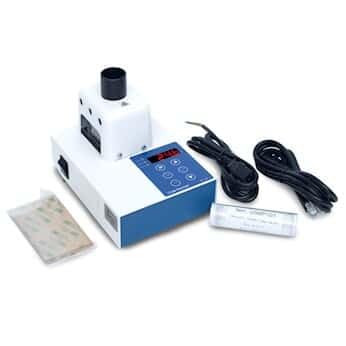
What the SMP20 actually does
The manual describes glass capillary samples placed in an aluminium block inside the sample chamber, with the sample viewed through a magnifying lens until melting occurs and the temperature then read from a large LED display.[1] Built-in illumination supports that visual observation, and the documentation allows two samples to be tested simultaneously.[1] That means two sample positions, not two independent programs or channels; both samples remain part of the same heated-block method.[1]
The documented workflow remains operator-observed melting followed by a temperature reading.[1] Do not assume that digital temperature means automatic endpoint recognition, camera capture, temperature history or report export. A displayed value alone is not a chemical-identity determination, purity certificate or clinical or regulatory verdict.
SMP20 controls and display
The SMP20 specification gives a four-digit LED display, 0.1°C resolution, and documented selectable ramp range of 1 to 10°C per minute.[1] The manual presents the adjustable rate as a way to trade speed against a slower, potentially more accurate observation, but that feature is not a guarantee of accuracy, repeatability, or a particular sample outcome.[1] The retail page also says the heating rate continues at 2°C per minute after warm-up, but the manual identifies fixed 2°C-per-minute melting as SMP10-only and gives the SMP20 its 1–10°C-per-minute control, so confirm the actual model and ramp controls if that difference is decisive.[1][2]
The manual documents a plateau function and an SMP20 display-hold control.[1] Hold is described as freezing the displayed value to give the operator more time to record it.[1] Do not mistake that description for a temperature-control hold, heater stop, automatic endpoint capture or event log. The shared manual’s unattended warm-up sentence names the SMP10; it is not an established safe-unattended-use promise for this SMP20.
How to interpret the numbers
The SMP20 specification lists a temperature range from ambient to 300°C, 0.1°C resolution, and published accuracy of ±1.0°C at 20°C and ±2.5°C at 300°C.[1] Resolution is the display increment, not accuracy, and those accuracy figures are point-specific published specifications rather than a uniform ±1°C claim or a measurement of your sample's uncertainty.[1]
The stated block range should also be kept separate from the operating environment: the manual specifies indoor, well-ventilated use at +5°C to +40°C and relative humidity not exceeding 80%.[1] Ambient-to-300°C does not establish active cooling below ambient, waterproofing, or a general laboratory certification. The hot block, glass components, and mains-powered equipment make qualified deployment and appropriate handling part of the fit, not something this review can validate by inspection.[1]
Identity and electrical fit
The selected listing identifies Stuart SMP20, AO-03011-45, 120 V, with COLE-PARMER in its manufacturer field.[2] An independent dealer record lists Stuart SMP20, SKU 03011-45, 120 V.[3] That is separately attributed model/voltage corroboration, not manufacturer documentation or proof of the selected seller’s shipment.
The family manual covers both 120 V, 60 Hz and 230 V, 50 Hz configurations, so it does not establish universal input.[1] It states 70 W power consumption and an earthing requirement.[1] Because the manual's generic lead description mentions UK three-pin and Schuko leads, confirm that the actual 120 V unit has a US-compatible earthed lead and matching rating label before relying on it for powered work.[1][2] That is a purchase-fit confirmation, not a conclusion that the 120 V model is wrong.
What is and is not established in the package
The reviewed documents establish the core SMP20 mechanism and controls, but they do not establish an itemized shipment manifest for capillaries, standards, calibration certificates, chemicals, or every accessory.[1][2] Two sample positions do not prove that two capillaries are included.[1] If your workflow depends on a particular consumable, standard, certificate, or supplied lead, verify that exact inclusion rather than treating the documented instrument mechanism as a full-carton promise.[2]
The manual’s generic declaration and inspection form do not establish that a particular offered unit has been independently tested or calibrated.[1] Confirm any required current warranty or individual certificate separately; a family document is not a substitute for those offer-specific terms.
The buying decision
Choose the SMP20 for operator-observed capillary melting with illuminated magnification, digital block temperature and the model’s documented adjustable ramp.[1] Look elsewhere if the required deliverable is an automatic endpoint, camera record, exported temperature history or an already validated identification result. For the selected 120 V offer, confirm the exact supplied lead and any consumables your method needs; where the ramp-control discrepancy affects the decision, confirm the offered SMP20 controls rather than trusting generic listing copy.[1][2]
As an Amazon Associate I earn from qualifying purchases.
Check the current Stuart SMP20 120 V offer on Amazon
Documentation note: the primary reference is the Stuart/Cole-Parmer SMP10 and SMP20 Instruction Manual, Version 2.3, retrieved from Cole-Parmer’s resource host.[1] Its family specifications and generic inspection form are not evidence of the seller’s shipped revision, plug or individual-unit test. The independent dealer record is used only to cross-check the SMP20/120 V ordering description.[3]